

It's Always About the Body
My vocation and my avocation are the same calling, wearing different clothes.

I know within the first few seconds.
Not in a mystical way — in a cellular way. The moment my hands settle onto a back, a shoulder, a forearm, the body tells me what it’s been carrying. Muscle memory isn’t just a metaphor. Tissue holds history. A neck pulled forward by years of staring at screens, shoulders rolled in and braced from decades of hunching over keyboards, an upper back rounded into the shape of someone who has spent more time looking down at a phone than up at the world — the body keeps score. I am in the business of reading the ledger.
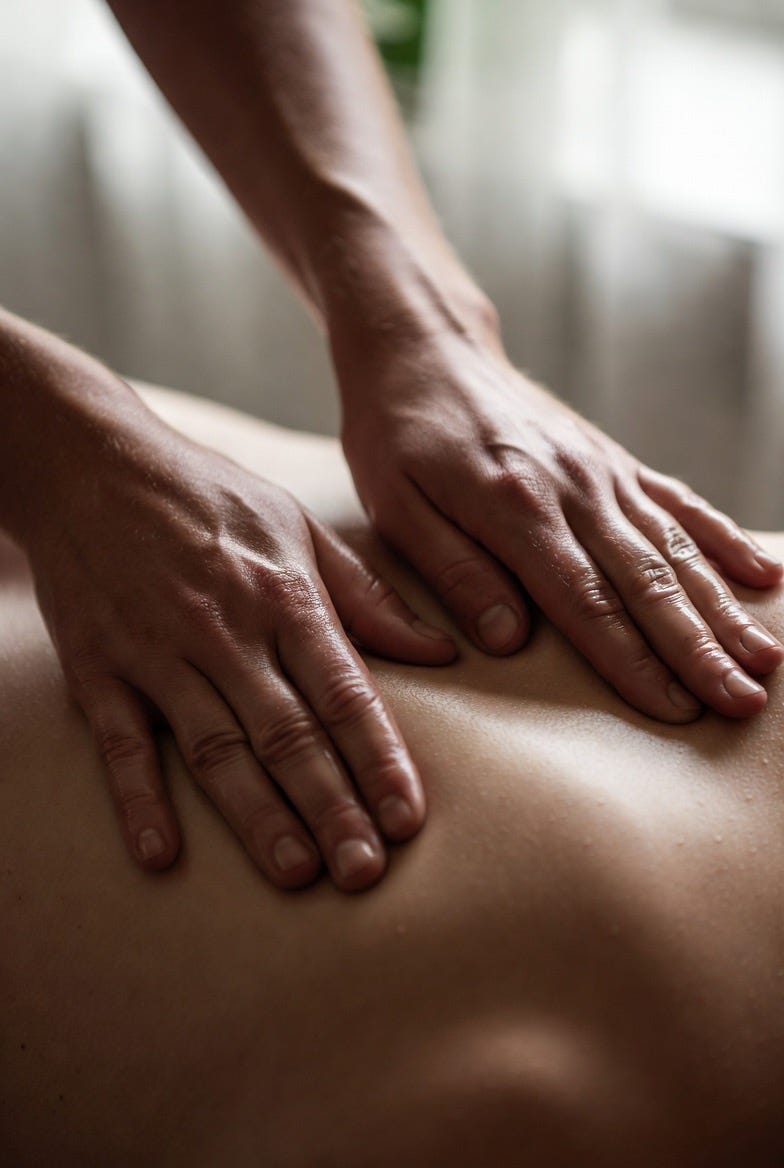
I’ve been doing this work for nearly three decades. Long enough that I don’t have to think about the differences anymore — they’re just there, the way grammar is there for someone who learned a language young. Female tissue. Male tissue. The architecture of bone, the distribution of fat, the density of muscle, the way skin moves over what’s underneath. These aren’t categories I was handed by a textbook and told to memorize. They’re things I know the way a carpenter knows the difference between oak and pine — through tens of thousands of hours of contact with the real thing.
Male and female bodies simply are different. I know this the way I know anything true: not because someone told me, but because I have put my hands on the evidence, every working day, for nearly three decades.
There is a particular kind of scar that forms when healing goes wrong.
The tissue fuses. It binds to what’s adjacent, tethers to layers it was never meant to touch, loses its ability to move independently. From the outside, it may look fine. The wound closed. The skin is smooth. But underneath, something is locked, and locked things ache in ways that are hard to locate and harder to explain.
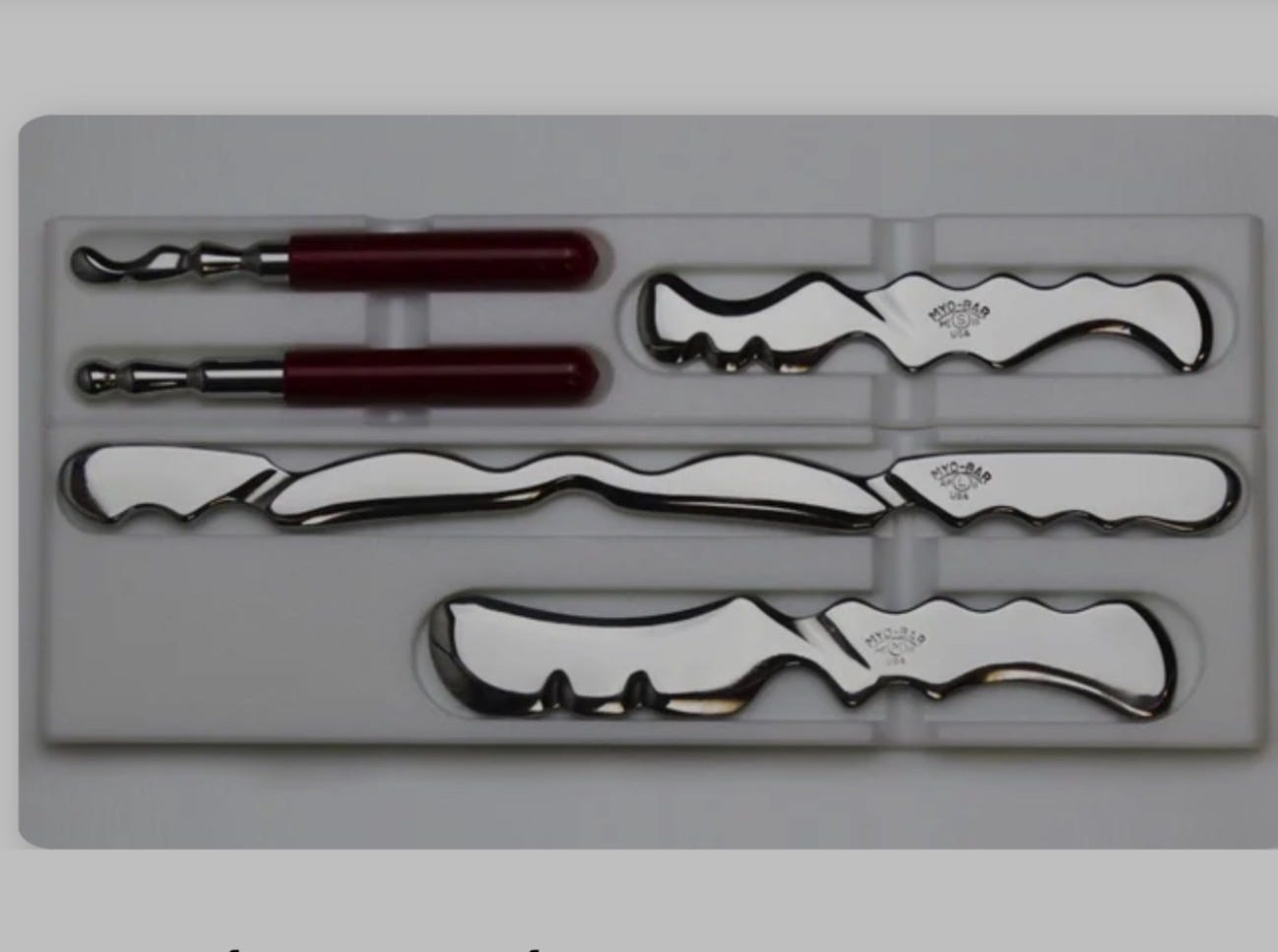
When I encounter that kind of scar, I reach for tools most people have never seen outside a clinical setting — steel IASTM instruments, precision-edged and deliberately heavy, designed to get under adhesions that hands alone can’t reach. Electric cupping to lift and separate tissue that has forgotten how to move freely. This is not gentle work, and I cannot do it alone. I need my client with me — their voice telling me when the pressure is deep enough, when it’s too much, when to hold and when to ease. We are partners in it. The tissue releases on its terms, not mine, and only when there is enough trust in the room to let it.
The rest of the work is different. Most of what I do is permission — creating the conditions for a body to finally, fully let go. When a client falls asleep on my table, that is not nothing. That is sometimes everything. In a world that runs on cortisol and screens and the low hum of continuous threat, getting a human body to surrender completely to safety is its own kind of healing. I do not take it lightly.
Clients sometimes tear up on the table and don’t know why. I know why. The body keeps the score long after we’ve stopped counting. All I can offer in that moment is the space — the breath, the stillness — to let it grieve what it’s been carrying alone.
I have learned to hold that space without flinching.
I do other work too, outside this room. I write. I am the communications director and head writer for the LGB Courage Coalition — and if you’re reading this, you already know what we cover. The systematic medicalization of gender-nonconforming children. The erasure of female-specific spaces. The ways radical trans activism has targeted gay men, lesbians, and women who dare to say no. The enforcement of an ideology that insists the body is incidental. A costume. A mistake to be corrected.
I didn’t go looking for this work. My mind had been opening since the summer of 2020 — the riots, the chaos, the moment I started questioning things I had never thought to question before. By April of 2022 I was on this specific journey, writing on my own, finding my voice, working through what I believed and why. I had been paying attention to the Coalition for a while. What sealed it was scrolling my X feed during Pride 2024 and landing on pictures of protesters outside the medical conferences — activists showing up, getting loud, doing the kind of work that reminded me of an older tradition. The LGB before the alphabet got longer. The movement before Obergefell, when it was still about liberation and not compulsion. I recognized it. Our paths merged the way I have come to believe paths do when they are supposed to. Same calling. Larger room.
I came to that work the same way I came to massage therapy: through contact with what’s real.
The young people whose stories we know — many of them girls who were told their discomfort with girlhood was proof they’d been born in the wrong body, boys convinced their adolescent confusion was a medical condition requiring intervention — they are not abstractions to me. They are people carrying scar tissue. Tissue that formed in the urgent, desperate work of surviving adolescence, of being told their bodies were the problem and that chemistry and surgery were the cure. Some of them had mastectomies before they were old enough to rent a car. Others were sterilized before they were old enough to understand what that meant. The body keeps score. Theirs are no exception. They grieve in ways that are hard to locate, and harder still to undo.
I know how to hold that space.
The ideology I write against would prefer I not trust my hands.
It would like me to treat the body as a declaration rather than a fact, as a feeling rather than a reality with its own logic and its own limits and its own deep, specific truth. It would like me to believe that male and female are categories imposed from outside rather than realities I have spent nearly three decades learning to read.
I can’t do that. My hands won’t let me.
What I know from the table is what I know from the page: bodies are not the enemy. They are the text. They are the whole point. Every scar tells a story about what happened. Every adhesion is a record of damage that needed to be survived. The work — whether I am doing it with my hands in a quiet room in Montgomery or doing it with words on a page — is the same work. Both require presence. Both require you to hold pain without absorbing it. Both begin with being trusted with something vulnerable.
When the writing gets dark — and it does get dark — I go back to the table. My hands on a body, the silence of the room, the simple undeniable realness of the work. It restores something. It reminds me what I know and why it matters.
My massage room is silent work. One client, one therapist, a shared intention. There is no negotiation in the middle of a session — only presence, and the work itself. I spent nearly three decades in that kind of relationship. And then I found myself writing alongside a team of strong-willed people, each of us with opinions, each of us with a different sense of where the piece should go. The push and pull of it still surprises me. So does how much better the work is for it. I am learning, still, what it means to build something with other people rather than alone.
I did not plan any of this. I did not sit down one day and decide to spend my life in service to bodies — the ones on my table and the ones in the headlines, the ones healing and the ones that have been harmed. I followed where I was led. I trust the One who has been doing the leading.
And I keep coming back to this: the crisis we cover was born on screens. These children were radicalized into disembodiment — taught to distrust what they felt, to treat their own flesh as the enemy, to live so entirely in their heads and their feeds that the body became a stranger. I think about that on the table sometimes. I think about what it would mean for them to feel safe enough to let go. To be brought back into themselves. To stop running from the one thing they were given that cannot be argued with.
The body keeps score. It has always kept score.
It’s always about the bodies. It has always been about the bodies.
It just took me a while to see I’d been doing the same job twice.
If you enjoy this content please like, subscribe, and share. Your paid subscription helps keep this work going!