

In a First, Idaho Expands Sex-Based Restrictions on Bathrooms and Changing Rooms to Private Businesses
Governor Brad Little signed the bill on International Transgender Day of Visibility.

On Tuesday, Idaho governor Brad Little signed a bill that bans a person from “knowingly and willfully” entering a restroom or changing room that is designated for “the opposite biological sex of such person.” HB 752 applies not only to schools and other government facilities but to all places of public accommodation, including private businesses. (Don’t razz Idaho for going with “biological sex” – yes it’s redundant, but these are the times we live in.)
The law is the first in the nation to extend statewide, sex-based bathroom and changing room restrictions to private businesses, which inspired hysterical media coverage when it passed the legislature last week.
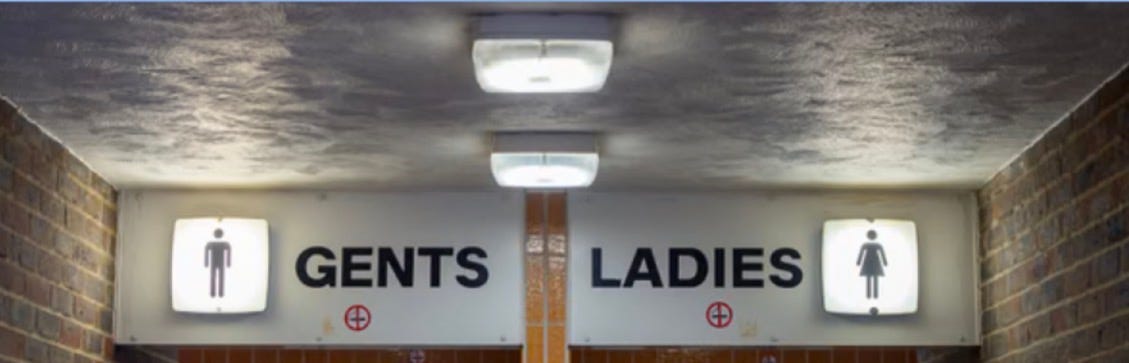
Can Trans People Still Pee in Idaho?
If your news consumption, like many people’s, consists mainly of scanning headlines, you might have assumed that starting July 1, whenever trans people in Idaho have to go to the bathroom, they better use the one at home, or go at a friend’s house, or else make a mad dash for the Oregon-Washington border, like that scene in “Hidden Figures” where a black female mathematician runs a frantic half-mile across the NASA campus because it’s the 1950s and there’s no “colored” restroom in her building. Some examples:
Reuters: “Idaho Passes Legislation Criminalizing Transgender Use of Public Bathrooms”
CBS: “Idaho bill that would criminalize transgender bathroom use heads to Gov. Little’s desk”
PBS: “Idaho bill aims to criminalize transgender bathroom use in private businesses”
ABC: “Idaho expands transgender bathroom ban to private businesses”
NBC: “Transgender Idahoan says bathroom bill could cause many to leave state”
Like recent stories claiming that “transgender women” are “banned” from the Olympics, these headlines are deliberately false and inflammatory. There is no logical explanation, beyond ideological capture, why a news organization can’t produce an accurate headline like “In a First, Idaho Expands Sex-Based Restrictions on Bathrooms and Changing Rooms to Private Businesses” and “Olympics Bans Males from the Female Category.”
Of Course They Can! Here’s What the Law Says
The Idaho law does not mention “transgender” or “gender identity,” which is infinitely wise, because the jury is eternally out on what these words even mean. The law says that men and boys must use the men’s facilities, and women and girls must use the women’s.
Also wisely, HB 752 specifically bans “knowingly and willingly” entering the wrong facility. Nobody wants to call the cops on a guy who accidentally enters the women’s room, realizes his mistake, and immediately exits. This is not rocket science.
The first offense is a misdemeanor, punishable up to one year in county jail. The second is a felony, which carries a maximum sentence of five years. Reasonable people may disagree over the potential severity of the penalty, but it’s worth noting that neither a felony nor a misdemeanor conviction has a mandatory minimum. A judge could impose probation, a fine, community service, a suspended sentence, or no jail time at all. The penalties are generally comparable to those for indecent exposure in most states, although a second offense in Idaho can bring 10 years.
Idaho’s existing law already required sex-separated facilities in public schools and colleges, domestic violence shelters, and correctional facilities. The move to extend restrictions to private businesses arose from an incident at a Sandpoint, Idaho YMCA where a lifeguard encountered an adult male in the women’s locker room. She reported it to management. Management explained, accurately, that it could do nothing because of a local ordinance that “allows an individual to use the locker room that aligns with their gender identity.” (Boise also has such a law.)
Opponents Try and Fail to Throw Women and Girls Under the Bus
Opponents argued that HB 752 criminalizes mere presence in a restroom rather than any harmful conduct, which is already covered by existing laws against indecent exposure, voyeurism, and sexual assault.
Well, no. Wherever gender self-ID (a man is a woman if he says so) is law, indecent exposure and voyeurism are nearly impossible to prove, and gender ID was law in parts of Idaho. A man who says he’s a woman has a right to be nude around women and girls in a locker room, and nothing compels him to avert his eyes when they undress. Also, laws against sexual assault, voyeurism, and indecent exposure are by definition reactive — they apply only after the offense has occurred.
By contrast, the Idaho law seeks to prevent what happens over and over again in California, Virginia, and wherever gender identity is protected under sex discrimination statute: By allowing men legal access to women’s facilities – what opponents dismiss as their mere “presence” – you inevitably allow men with criminal histories and ill intent access to women and girls at their most vulnerable. And because gender identity is legally protected, business and law enforcement will err on the side of not being sued by these men, rather than protecting women’s safety and privacy. Examples abound; here are but a few.
In Los Angeles, Darren Merager, a man with prior indecent exposure convictions entered Wi Spa’s women’s section while visibly aroused. Women who complained were dismissed as transphobes. Another California man caught masturbating in a Planet Fitness women’s bathroom stall claimed transgender status when confronted; staff and police did nothing. In Beverly Hills, Alexis Black, a man with a domestic violence record that includes breaking his ex-wife’s jaw, repeatedly paraded around nude and harassed women in a Gold’s Gym locker room under the gym’s gender identity policy. When rapper Tish Hyman objected, her membership was revoked. In Arlington, Virginia, a registered sex offender gained access to women’s locker rooms by declaring himself female. He was observed naked and touching himself in front of women and children. Investigators later found child pornography and children’s activity schedules on his phone. In each of these cases, women who raised concerns about a male in their locker room were told he had the right to be there.
Here’s a collection of more than 20 news stories about men caught videoing women in women’s changing rooms in the U.S.; most gained access by claiming to be female. Here are three more stories from Maryland, Ohio, and California. Police statistics from the UK and Wales record at least 16 rapes, 80 sexual assaults, and 65 acts of voyeurism in mixed-sex changing rooms in 2023.
A New York Times story with the bizarrely coy headline — “Idaho Criminalizes Transgender Use of Some Bathrooms in Private Businesses” — reported that “a majority of Republicans, particularly harder-line conservatives,” viewed the law as a way to protect women and children. Apparently nobody else The Times talked to thought much about that. They were more concerned about “the overall campaign to purge the state of trans folks” and “trying to cast stones at transgender people” and “ignoring the fact that these are people just like us. What are they supposed to do?”
Some law enforcement leaders claimed the law would be impossible to enforce and would place officers in the position of visually determining someone’s biological sex, which is another red herring. Bathroom norms were enforced for generations before gender self-identification policies upended them: someone sees a person of the opposite sex in a sex-designated facility, alerts staff or calls the police, and the situation is addressed. The law doesn’t require officers to stand outside restrooms checking ID any more than laws against shoplifting require them to monitor every aisle of a store.
In a piece for The Advocate, Idaho activist Nikson Mathews, a trans-identified woman and local activist, claims that the law forces her to choose between “going to jail” and “being attacked.” Mathews is a burly person with a beard and male-pattern baldness. Like many such trans men, she passes and presumably uses the men’s room without incident. Even if a man were to clock her as female, men are highly unlikely to call the police on a female using the men’s room. The threat just isn’t there, as it is with men in the women’s room. It’s possible someone like Mathews would cause alarm in the women’s facilities, which is why she probably shouldn’t use them, but you know what? That’s on her. Just as a man’s decision to identify as a woman – whether he looks like one or not – is on him.
Women and girls shouldn’t bear the cost of someone else’s choices about their appearance and their “identity.” Sex-based spaces exist to protect the privacy and safety of the people they were designed for, and the rights of the many shouldn’t be overridden by the preferences of the few.
Did the Governor Know What Day It Was?
Nobody knows for certain whether Governor Little intentionally signed the bill on International Transgender Day of Visibility, which takes place each year on March 31.
What we do know is that the governor had five days to act on the bill, so he didn’t have to sign it that day. He received the bill on Monday around 4:50 p.m. and signed it into law on Tuesday at 1:30 p.m.
Nikson Mathews said the governor signed HB 752 while activists were holding a Transgender Day of Visibility rally in front of the statehouse. “He signed it while we held a TDOV rally out front,” Mathews told The Advocate.
 | A guest post by
|