

Upside Down Pride:
When Pride Stops Being About Self-Acceptance

By Anonymous
When I came out in 1986, the gay community was embattled. It was the height of the AIDS epidemic, and it was not unusual to hear people say that gays deserved AIDS, that the suffering and death caused by the disease were God’s righteous judgment on deviants, perverts, and sinners. At the time, I partially bought into that narrative, almost against my will, and it left me filled with self-doubt and self-hatred.
Learning to trust myself, to let go of that shame, and to accept who I was took years. In many ways, it shaped the person I became. I did not choose to be gay, but after years of struggle I learned not only to accept myself, but to be proud of who I was.
I remember my first Pride parade in my hometown of Pittsburgh. It included no more than a few hundred people walking down the street. Some carried signs. Some held their partners’ hands. Others wore paper bags over their heads with their professions written across them fearing for their jobs if they were recognized.
There were few spectators and virtually no corporate sponsors. It was simply a group of gay people refusing to hide. The atmosphere was one of defiance, courage, and hard-won pride. Many of us felt righteous anger toward those who insisted we deserved to die. Beneath that anger, however, was something deeper. It was a fierce acceptance of ourselves.
We were done apologizing for who we were.
Pride was both a celebration and a declaration. It was a loud refusal to be shamed and an even louder affirmation of ourselves.
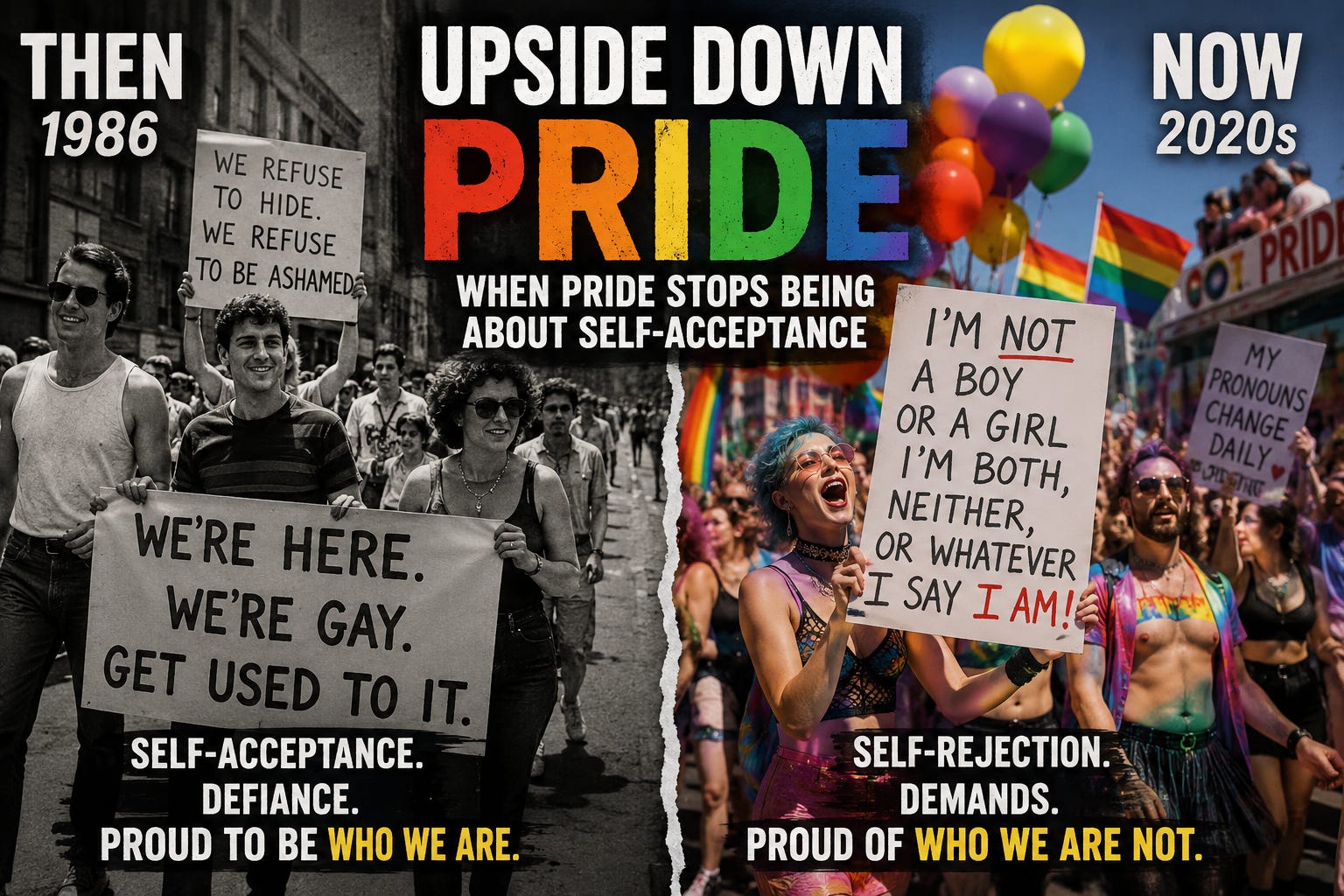
Now its message has been turned upside down.
Pride has increasingly become a celebration of our supposed right not to be who we are while demanding that everyone else agree with us. We are no longer simply boys and girls. We are told we can be neither, both, or the opposite. We no longer ask only to be left alone to live our lives freely. We demand that society affirms our identities even when they conflict with reality.
It is no longer about being accepted for who we are.
It is about being accepted for who we are not.
At the heart of this inversion is the belief that we no longer need to accept the reality of ourselves and our bodies. Instead of doing the difficult and painful work of making peace with who we are, we are told we should become someone else.
Being trans or nonbinary begins with rejecting one’s sexed body and experiencing profound discomfort with oneself as one is. It is not rooted in self-acceptance. Wanting to transition is not an act of self-love. It is an act of self-rejection. To me, it expresses the very antithesis of what Pride once meant.
Wanting to opt out of your own sex is, in many ways, analogous to wanting to opt out of your sexual orientation. We used to call people who insisted they were straight while experiencing exclusive same-sex attraction “closet cases.” Traditionally, the gay community celebrated honesty and confronted denial. In some controversial cases, we even outed anti-gay public figures who were secretly gay because many believed that doing so affirmed the reality of homosexual orientation. We were no longer willing to hide who we were or make it comfortable for others to pretend to be something they were not.
Today, I believe what is done in the name of Pride is the opposite.
Instead of encouraging people experiencing gender dysphoria to come to terms with the reality of their bodies, we affirm and celebrate the desire to become something they cannot actually be. Rather than encouraging self-acceptance, we affirm self-rejection. In many cases, that rejection is reinforced through hormones and surgeries to reshape the body.
Being yourself is no longer the courageous act. Instead, presenting yourself as something other than who you actually are is counted as the celebrated act of courage.
When I first came out, I often felt that if someone had offered me a magic pill that would make me straight, I would have taken it without hesitation. Looking back, I can see that desire sprang from deep-seated self-hatred. It did not come from a place of acceptance or self-love.
Today, however, we have drugs and surgeries to dramatically change a person’s appearance. They offer what can feel like an escape from the painful work of self-acceptance by allowing someone to construct a version of themselves that feels more acceptable.
I want to make it clear that I am not trying to punish transgender people, deny the reality of gender dysphoria, or minimize the suffering felt by those in its grip. My goal is to promote reality-based thinking and to shift the conversation from affirmation (i.e. self-rejection) toward self-acceptance.
Affirming a wished-for reality while ignoring actual reality does not ultimately help anyone.
A life posing as something you are not is extraordinarily difficult. Ask any former closet case. To build your life around becoming something you can never actually be is likely to bring heartache.
Still self-acceptance is difficult work.
Our bodies are part of who we are. We can alter them dramatically, but we cannot opt out of them. At the end of the day, we remain the sex into which we were born. We can either make peace with that reality or remain at war with the truth.
For that reason, I believe resolving gender dysphoria psychologically, where possible, is far healthier than attempting to appease it by radically restructuring the body into a facsimile of something it can never be.
Many LGBT+ organizations double down on the right to present oneself as something one is not while treating the prospect of self-acceptance as suspect. They slander those trying to help people accept their bodies by calling it conversion therapy, meanwhile promoting the rejection of one’s embodied reality as “authenticity.”
To me, this is a betrayal of what Pride once represented.
It is as though today’s Pride encourages people to be proud of not liking who they are. That strikes me as a destructive message because it places people in conflict with themselves. An identity built upon a wished-for but ultimately unattainable reality is an inherently fragile one.
This is, in my view, the fundamental difference between LGB pride and this new Transgender brand of Pride.
Transgender Pride is rooted in self-rejection, specifically the rejection of one’s sexed body. LGB Pride is rooted in self-acceptance.
The movement for Gay, Lesbian, and Bisexual rights challenges society to allow us to be who we are and to love whom we love. It is a demand that asks very little of others beyond equal treatment and freedom from persecution.
“Transgender Rights”, as they are commonly articulated today, demands that society accept people as members of the opposite sex. They require others to pretend to believe something at odds with reality. Whether one agrees to that arrangement or not, it is fundamentally different from the claims made by the traditional Gay Rights Movement.
The Gay Rights Movement did not become strong by rejecting reality or using obfuscatory language. It gained strength by embracing both. If we are to maintain a coherent definition of woman, then trans women are not literally women. The same is true of trans men.
We learned to stop apologizing for who we were. We learned to reject shame instead of rejecting ourselves. Pride was never about escaping reality. It was about finding the courage to live honestly within it.
But somewhere along the way, we lost our way.
If Pride is to mean anything again, it must return to its roots. It must once again become a celebration of self-acceptance rather than self-rejection, of reality rather than wishful thinking, and of the quiet courage to be exactly who we are.
Our opponents are well-funded. We aren’t. Everything we do—from publishing stories like this one to organizing testimony across the country—depends on the support of people just like you. If this work has value to you, please become a paid subscriber or make a donation today. Your support keeps this movement alive.
Visit our website to help fund the reporting, advocacy, legislative testimony, educational outreach, and community-building efforts that make the LGB Courage Coalition a leading national voice for evidence-based care and homosexual rights. Paid subscriptions and donations are what make all of this possible.
This piece was contributed by a gay man and professional therapist.
Gay and Lesbian Freedom was about… freedom until 1996, the freedom to not be harassed and arrested for associating with someone of the same sex in a bar, or walking down the street holding hands without assault.
Not pride, but freedom day.
https://www.bolerium.com/pages/books/19386/lesbian-gay-freedom-day-committee/1987-san-francisco-lesbian-gay-freedom-day-parade-and-celebration-proud-strong-united-parade-87
This article really hits the nail squarely on the head many times. The following paragraph describes so accurately the reality of someone trying to live as the sex they are not, for so many who attempt it:
"A life posing as something you are not is extraordinarily difficult. Ask any former closet case. To build your life around becoming something you can never actually be is likely to bring heartache."
I have seen this permanent ongoing struggle, and resultant anxiety, in many people who transitioned. The difficulties of life-long posing is never addressed in "affirmation only" therapy. Add to that the grim reality of the surgeries and how they negatively impact health and normal function, and the most likely result is a far more difficult life, compared to finding acceptance with one's natural body and sex.
It is refreshing to read that the anonymous writer of this essay is a therapist. He goes on to say:
"For that reason, I believe resolving gender dysphoria psychologically, where possible, is far healthier than attempting to appease it by radically restructuring the body into a facsimile of something it can never be."
When transsexual transitions and surgeries firsst became more widely publicized and promoted in the 1960's, Dr. Harry Benjamin with his book, The Transsexual Phenomenon, declared (and others follwed suit) that therapy was not effective in dissuading cross gender identification.
More recently, Dr. Az Hakeem showed that therapy for cross sex identified people to accept one's birth sex was very effective, when he brought those who regretted transition and surgery together with those who were just starting on that path.
Going forward it's imperative that we recognize and expose how inherently damaging the "affirmation only" treatment of gender dysphoric people is, and instead, embrace therapies that treat and heal the underlying traumas that cause gender dysphoria.