

The Heretics List
A group of scientists just signed a statement saying females produce eggs.

That stating this simple fact has become a revolutionary act tells you exactly where we are as a society. As one of the commenters on Emma Hilton’s substack Fond of Beetles, put it “How convenient to have a list of heretics.”
The remark was tongue-in-cheek, but he wasn’t wrong.
Project Nettie is a public declaration, and brainchild of developmental biologist Dr. Emma Hilton and co-founderJenny Whyte, which collects the signatures of scientists, doctors, and academics who endorse a gamete-based definition of biological sex. The declaration runs to only five short paragraphs. Its summary is a refresher in basic biology: males and females are defined by their reproductive functions; this division is a product of evolutionary history; sex is fixed in early embryonic development and doesn’t change across a lifespan; and attempts to recast biological sex as a social construct are “wholly ideological, scientifically inaccurate and socially irresponsible.”
Behold the new heresy.
It is not a political manifesto. It is not a personal attack. It is not even a denial of gender identity. Instead, the project is a concise return to the foundational biology taught in secondary schools and medical colleges for over a century. Its namesake is Nettie Stevens, the American geneticist who in 1905 discovered sex chromosomes in mealworm beetles..How bizarre that the very work establishing the field would now render its architect a bigot in the eyes of her own professional descendants.
Project Nettie launched in 2019. The timing reflects a reaction to a decade of steady institutional retreat from reason.
How we got here
The years leading up to 2019 saw a sustained effort within academic journals and professional bodies to reclassify biological sex as “unsettled.” A new literature emerged, positing that sex exists on a spectrum and that binary sex categories are a social imposition on biological complexity. Intersex conditions were regularly deployed as a proxy to undermine the male/female framework entirely. These claims were rarely made transparently ; they were wrapped in appeals to nuance and compassion. Challenging the narrative was treated as a failure of character..
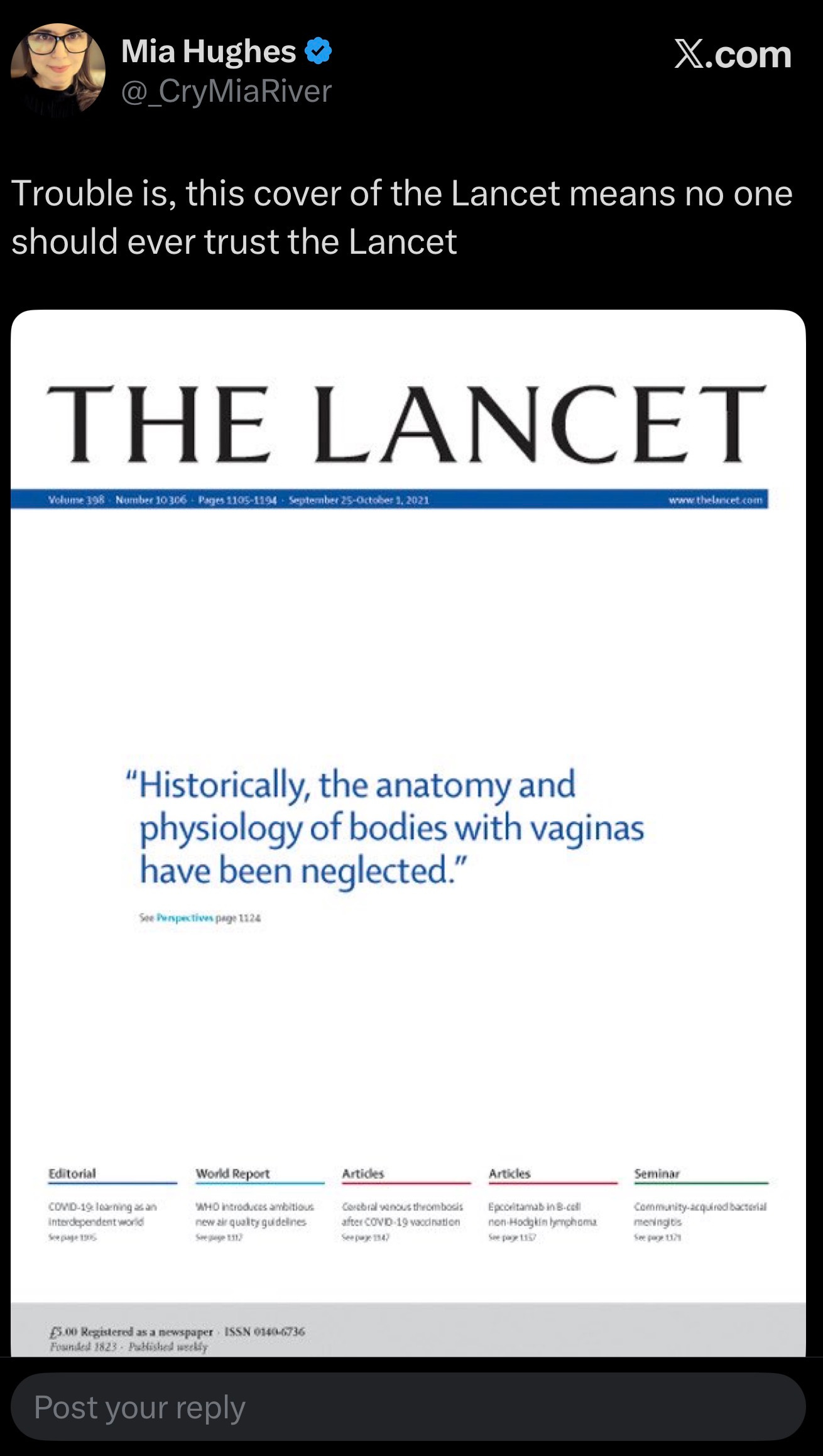
The effects were practical and immediate. In September 2021, the cover of The Lancet – a pillar of medical publishing for two centuries – carried a striking pull quote: “Historically, the anatomy and physiology of bodies with vaginas have been neglected.” Not women. Bodies with vaginas. In a journal about women’s health the word “women” had been edited out of the discussion.
The ensuing backlash forced an apology out of the editor-in-chief, but the institutional damage was done. As researcher Mia Hughes (@_CryMiaRiver) noted, “Trouble is, this cover of the Lancet means no one should ever trust the Lancet.” Once ideology overrides precision of language, the credibility of the publication evaporates. And this was not an isolated incident. Other medical journals began substituting “pregnant people” for “pregnant women,” while professional bodies prioritized “gender identity” in clinical contexts where sex is the only relevant variable. Researchers attempting to flag methodologically weak studies were dismissed as morally suspect, and their critiques went unpublished.
This was not the self-correcting mechanism of science in action. Science corrects itself through replication, rigorous peer review, and the steady accumulation of evidence. Instead ideology invaded the literature by taking the low road of editorial activism and institutional capture .
Project Nettie was one response to an environment in which dissent had become a barrier to entry.
The signatories
The list of signatories found on Hilton’s Substack is worth reading in full, not for the prominence of those who have signed (although some names are well known), but for the depth of their professional commitment. These are not retired academics with nothing left to lose; they are active clinicians at the peaks of their careers. The list spans emergency medicine, pediatrics, psychiatry, endocrinology, pathology, and general practice.
Notable signatories include:
William Malone, an endocrinologist at the forefront of the debate over the use ofcross-sex hormones and puberty blockers on children and adolescents
Melanie Newbould, a pediatric pathologist and Fellow of the Royal College of Pathologists
David Curtis, a fellow of the Royal College of Psychiatrists with a PhD in genetics from Cambridge
Ryan Clark, a consultant in emergency and pediatric emergency medicine
Lord David Triesman and Lewis Moonie, both members of the House of Lords with backgrounds in epidemiology and psychiatry.
These are not fringe figures. They are credentialed experts in fields where misdefining biological sex has direct, negative consequences for patient care.
Project Nettie maintains an explicit demarcation between its core scientific signatories and its “supporting signatories” – academics from sociology, philosophy, law, and other disciplines. This distinction is vital. It does not inviteHistorians and lawyers to opine on biology. Their inclusion is a testament to a a broader reality: that for those who work with material data daily, the science is not in dispute.
The statement has one job: to stand as a public record that a significant body of scientists and clinicians still affirms the biological reality that the rest of the world has begun to treat as an optional social construct.
What a list says
The existence of such a list is a symptom of an ailing scientific community.
Such declarations do not appear in healthy environments; they emerge only when institutional capture by ideologues and frauds is so near-total that stating the most basic of biological truths requires a formal act of defiance. This list is not merely a record of consensus, but a map of the resistance—a ledger of those willing to tether their professional reputations to material facts within an environment threatened by enforced delusion.
That courage has costs. Hilton herself has faced professional hostility for her public positions on biological sex. Others on the list have faced similar treatment. The signatories know what they’re doing when they add their names, which makes the list more than a record of who believes what, but who also had the courage to step forward.
In observance of Women’s History Month, it is imperative to reclaim the legacy of the woman who provides this project with its name and its moral anchor: Nettie Stevens.
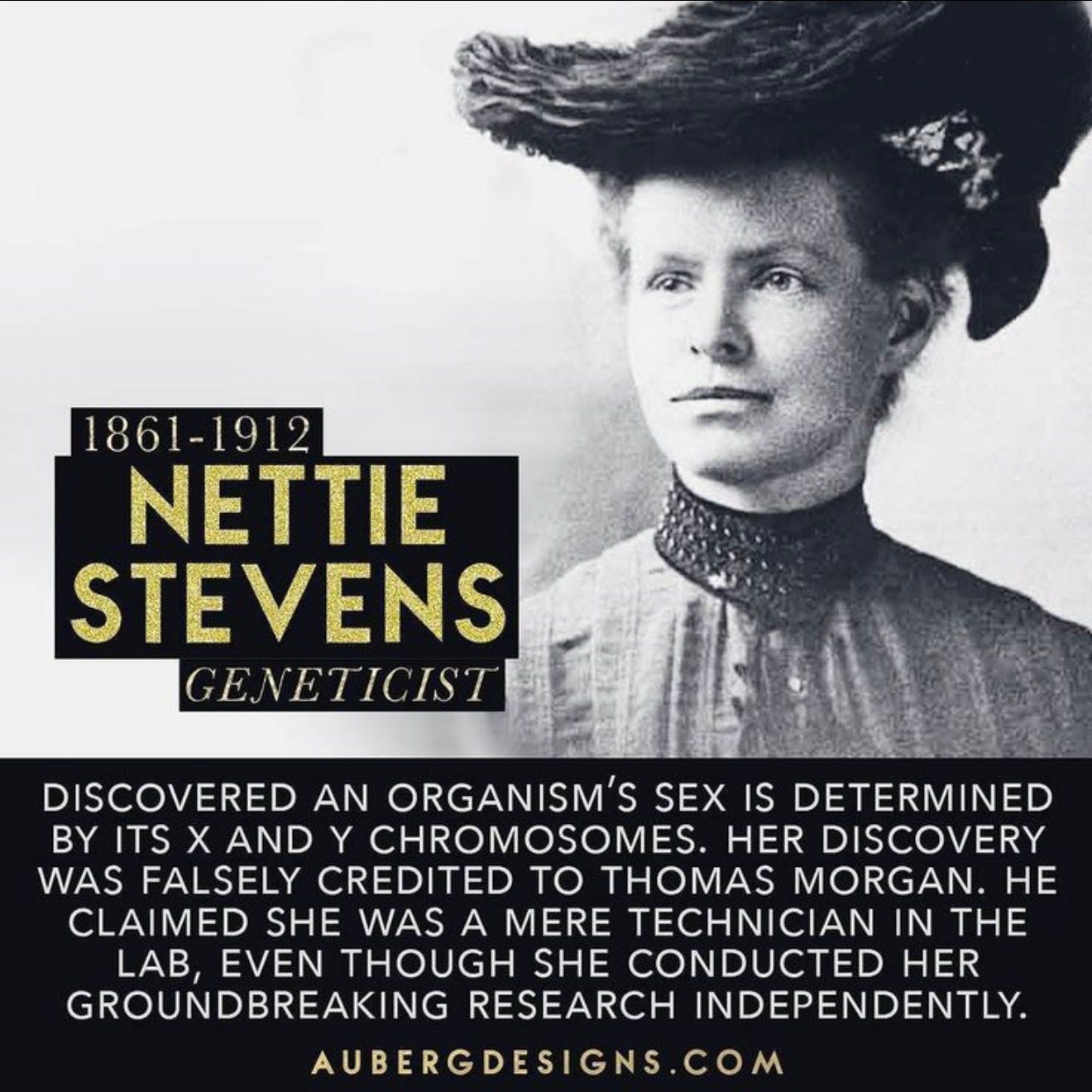
Nettie Maria Stevens was born in Vermont in 1861. She didn’t begin her scientific career until her thirties, funding her own education through teaching and library work before earning her PhD from Bryn Mawr College in 1903. While working with mealworm beetles, she discovered material evidence for sexual dimorphism: the specific chromosomal pairingwe now know as X and Y. Hers was one of the most significant discoveries in the history of biology. Before she could witness how foundational her work truly was, she died of breast cancer in 1912 at age 50.
Stevens didn’t sign declarations affirming the existence of sex chromosomes; she provided the proof that made them unnecessary. Despite the limits imposed on professional women in 1905, her professional environment at least allowed her to follow the evidence where it led without fear of institutional reprisal. A century and twenty years later, the specialists who rely on her work are forced to petition for the right to acknowledge it. This inversion is a diagnostic for a field in crisis—a sign that the professional cost of stating the obvious has become a barrier to scientific truth.
What you can do
If you are a scientist, clinician, or academic who hasn’t signed yet, it’s not too late. You can find Emma Hilton’s contact information on her Substack post. All signatories must provide credentials, institutional affiliation, and a link to a professional profile.
Even if you’re not in a qualifying field, you can share the list, talk about it, and push back whenever someone repeats the lie that no credentialed scientists hold a binary view of biological sex. Plenty do. And over a hundred of them are willing to bank their professional reputations on it. The list continues to grow.
Today’s heretics are defending their position in the historical record. That’s the first step towards much-needed reform.
Powerful, incisive writing about an encouraging and authoritative element of the resistance. I'm grateful, too, to see this attention paid to Nettie Stevens, whose place in history should be reinforced no less than the sex binary. Thanks so much.
Excellent article! Just excellent. Thank you for your commitment to keeping us informed.