


Wikipedia’s reputation was and perhaps still is one of a mostly neutral record — a collaborative project of global knowledge where “the facts” are found. However, it’s become clear that Wikipedia does not merely reflect reality, but often attempts to shape and filter it through an ideological lens.
Israel v. Gaza: Manufactured Consensus
The recent dust-up over a Wikipedia article called Gaza genocide is a case in point. As documented in ‘Pandemonium’ at Wikipedia Over Gaza, internal moderators wrote the article to conform to a disputed political position, that Israel was committing “genocide” in Gaza. Wikipedia co-founder Jimmy Wales called out the article’s opening sentence, which declares in “wikivoice,” Wikipedia’s own voice (not a summary of other opinions): “The Gaza genocide is the ongoing, intentional, and systematic destruction of the Palestinian people…”
Wikipedia’s other co-founder Larry Sanger went further. In his Nine Theses on Wikipedia Governance, Sanger argues that Wikipedia no longer functions as an encyclopedia but as an ideological system controlled by a small, anonymous cadre who enforce consensus, not truth.

“Wikipedia’s policy of deciding editorial disputes by working toward a ‘consensus’ position is absurd,” Sanger writes. “Its notion of consensus is an institutional fiction, supported because it hides legitimate dissent under a false veneer of unanimity…[a] neutrality dispute should never be an attempt to determine which side is correct, or which side has the right to assert its views.” Rather, Sanger reminds us, Wikipedia should present a range of germane, noteworthy views on a topic so that “readers may make up their minds for themselves.”
What Wikipedia editors often produce instead is a manufactured consensus — the appearance of agreement created by gatekeeping and attrition. No topics on Wikipedia reveal this one-sided “consensus” dynamic more clearly than those dealing with gender identity and gender-affirming care.
The “Misinformation” Narrative
Wikipedia’s Transgender health care misinformation page calls the following findings “false” or “misinformation”: Most trans-identifying children are gay and “identify as trans because of internalized homophobia”; “most pre-pubertal transgender children [sic] cease desiring transition after puberty”; “children are transitioned too quickly”; and “gender dysphoria is socially contagious, can have a rapid onset, or is caused by mental illness.”
Moreover, the article characterizes as “an unfounded narrative” the idea that “gender dysphoria is caused by underlying mental illness, trauma, or neurodivergence, such as autism and ADHD. The Wiki article goes on to assert, “though transgender people have higher rates of mental illness, there is no evidence these cause gender dysphoria and evidence suggests this [mental illness] is due to minority stress and discrimination experienced by transgender people.”
Few findings in the realm of gender identity and transition are settled science, but certainly reasoned arguments exist for these positions that Wikipedia summarily dismisses as misinformation.
ROGD Is “Controversial,” Littman’s Sources Are “Anti-trans”
Rapid onset gender dysphoria (ROGD) was first identified in a peer-reviewed study by physician and researcher Lisa Littman in PLOS One (2018). The phenomenon has since been noted by researchers in the U.K.(Cass Review) and other European countries, and in a comprehensive review of evidence and best practices by the U.S. Department of Health and Human Services.
However, a search on Wikipedia for “rapid-onset gender dysphoria” immediately redirects to Rapid-onset gender dysphoria controversy (emphasis ours). The first sentence of the entry describes ROGD as “a controversial, scientifically unsupported hypothesis.” Most of the article is taken up with criticism and condemnation of Littman’s paper, with no significant discussion of the paper itself. A brief paragraph cites support from “conservative media outlets” while no detractors are characterized as “left” or “liberal”.
Both the second and third paragraphs state that Littman’s study was based on surveys from parents of transgender youth recruited from “anti-trans websites.” A closer look at the four sites known to have participated shows Wikipedia trafficking in a favorite trope of trans activists – any individual or organization that expresses any reservations whatsoever about gender transition is dismissed as “anti-trans.”
That includes parents alarmed by the rush to irreversibly medicalize their child’s distress (TransgenderTrend, 4thWaveNow); parents in a Facebook group described by GLAAD as “gender-affirming” (Parents of Transgender Children); formerly trans-identifying adults (4thWaveNow); and a group of psychologists, social workers, and doctors who described themselves as “left-leaning, open-minded, and pro-gay rights” (Youth Trans Critical Professionals). These descriptions came from the groups’ websites, as quoted and summarized in Littman’s paper.
Littman has defended her research in interviews, noting that the controversy brought more attention to the phenomenon she was describing and that clinicians who had been seeing this presentation in their practices now had language to discuss it.
The ROGD “controversy” reflects activist backlash, not scientific refutation. Wikipedia fails to mention that most major health authorities in Sweden, Finland, and the U.K. have already retreated from affirmation-first models precisely because the pattern Littman described is unfolding before their eyes. The label of “controversial” works like the ideologue’s thumb on the scale — it signals to readers that certain findings are heretical.
SEGM and Genspect Are “Hate Groups”
The Society for Evidence-based Gender Medicine (SEGM) is, according to its website, an organization of physicians, psychologists, and researchers who analyze peer-reviewed studies to promote evidence-based treatment of children and young adults with gender dysphoria. SEGM opposes medicalized youth transition in the absence of evidence supporting it, and supports non-invasive approaches like psychotherapy. Its membership includes prominent youth gender clinicians such as Ken Zucker, Ray Blanchard, and Stephen Levine (who are dubbed “fringe” in Transgender health care misinformation).
Wikipedia says SEGM “is known for transgender health care misinformation” and “has falsely claimed that the majority of transgender children desist.” It calls SEGM and Genspect “hate groups” and SEGM “a hub of pseudoscience,” citing the Southern Poverty Law Center (SPLC). That’s all in the first two paragraphs.
Never mind that studies and anecdotal evidence accumulated over decades show the majority of gender dysphoric youth do desist, if not proactively affirmed. And never mind that the SPLC has no medical or scientific remit, or that a federal judge ruled in a defamation lawsuit that its “hate group” label is an “entirely subjective” opinion. Wikipedia’s article on SEGM is shot through with accusations of “far right” and “bias.”
SEGM’s detailed rebuttal notes that the SPLC’s 150-page report “provided no evidence to support its own definition” of a hate group as it applies to SEGM, and relied on an activist citation loop. The organization also notes that “our president and many of our collaborators are members of the LGBTQ community.”
Exploratory Therapy Is “Conversion Therapy”
“Gender exploratory therapy (GET) is a form of conversion therapy characterized by requiring mandatory extended talk therapy…” is how Wikipedia’s Gender exploratory therapy section opens. As part of a main article, Conversion therapy, the exploratory therapy discussion is conflated with conversion therapy as commonly known in the bad old days – the harmful, long-discredited practice of trying to turn gay people straight. Not surprisingly, the article doesn’t explore whether gender transition – which ensnares so many same-sex attracted young people – is the true conversion therapy.
Detransition Is a Tool of the Right
Throughout Wikipedia’s article on it, detransition is portrayed as a right-wing stalking horse for “conversion therapy” and oppressing trans people.
In the second paragraph we learn that “Some organizations with ties to conversion therapy have used detransition narratives to push transphobic rhetoric and legislation.” The Background and terminology section tells us “The term [detransition] has become associated with movements that aim to restrict the access of transgender people to transition-related healthcare by over-emphasizing the risk of regret and detransition.”
Nearly all of the lengthy Cultural and political impact section contextualizes detransition as more or less a “moral panic” that “has attracted interest from both social conservatives and gender-critical feminists on the political right.”
The section deceptively ties detransition to “conversion therapy” and leans heavily on religious opposition: “Many ex-gay and Christian right organizations discourage transition, promote reversal or desistance of transition, and to change individuals’ gender identities. A key characteristic of these organizations are the construction of ‘transgenderism’ as a sin against God or the natural order.”
The only detransitioners mentioned by name are an “ex-transsexual” who was platformed by the anti-gay Exodus International in the 1970s and two female “ex-detransitioners” who describe being involved in “transphobic” detransitioner communities before creating an organization called Health Liberation Now. This group “has reported on conversion therapy practices and maintains resources to help identify relationships between clinical conversion therapists and astroturfed campaigns led by anti-trans groups.”
There’s a Forced medical detransition section, which refers mainly to transgender people who can no longer access treatment because of legal restrictions or because they’re in prison. It also includes a harrowing account of a Saudi trans woman “who committed suicide after being forcefully detransitioned.”
Meanwhile, the proliferation of detransitioner lawsuits and the basis for these lawsuits doesn’t rate a mention. Wikipedia does have a Category: People who detransitioned page with only 17 entries. Laura Becker, Clementine Breen, and Prisha Mosely are among the notably missing.
At Wikipedia’s content policy level, Wikipedia:Identifying reliable sources (medicine) requires that biomedical content be based on “reliable, third-party published secondary sources” and that primary sources “generally not be used for medical content.” In practice, this means detransitioners’ own accounts of their surgeries, complications, and decisions to detransition are treated as anecdotal primary sources that can be quoted as personal stories but cannot be used to establish general claims about transition outcomes.
Glaring Omission in the Life of Rachel “No Limits” Levine
Wikipedia’s article about former Assistant Secretary of Health Rachel Levine neglects to mention a significant event, although it was widely reported in The New York Times and elsewhere.
Internal WPATH documents and emails reveal how Levine secretly and successfully pressured the organization to remove all age limits for gender surgeries from its standards of care, over concern that limits would somehow aid political opponents of such treatments. WPATH’s 2021 draft guidelines had already recommended lowering age minimums for hormones and surgeries. But that wasn’t good enough for Levine, himself a trans-identified man who has said he’s glad he transitioned later in life, so he could have kids.
The political fallout and public outcry from this story caused the White House to announce that actually, on second thought, the Biden Administration now opposed gender surgeries on minors.
Not a word of the kerfuffle made it into Wikipedia’s article about Levine. And of course it ignored Lauren Leggieri’s epic j’accuse (“Stop transing gay kids!”) during Levine’s speech at the 2024 American Academy of Pediatrics conference.
Andy Ngo and the Feedback Loop of Slander
Wikipedia’s distortions do not stay on Wikipedia. Google searches treat Wikipedia as authoritative, usually surfacing its articles at or near the top of results. Thus distortions spill outward — into search results, classrooms, newsrooms, and AI systems — until distortion becomes ‘common knowledge’.
Journalist Andy Ngo knows firsthand how this process works. As he reports in his Ngo Comment substack, after he was beaten within an inch of his life by a Portland mob, partisan writers rushed to publish defamatory articles about him. Wikipedia editors then cited those same articles as “sources,” embedding the smears into his public profile. One prominent UK newspaper, The Independent, was forced to publish a lengthy retraction. (The Independent is still cited four times in Ngo’s Wikipedia bio.) Google search results for Andy Ngo lead with the Wikipedia article, where the first sentence tells us he’s a “right-wing social media influencer.”
The Erasure of Jamie Reed
Jamie Reed, cofounder of the LGB Courage Coalition, documented the reckless medicalization of minors at the Washington University Transgender Center. Her sworn affidavit and legislative testimony exposed minimal evaluation protocols, surges of adolescent girls presenting with sudden gender dysphoria, and a conveyor belt of hormone prescriptions.
Her disclosures in a Free Press story went massively viral, sparked investigations, and drove policy reforms. Yet Jamie Reed has no Wikipedia page.
Meanwhile, Erin Reed, a social-media activist with no clinical background, is presented as a reliable authority despite documented inaccuracies in his reporting by established journalists like Ben Ryan.
Shocker: Wikipedia Doesn’t Know What a Woman Is
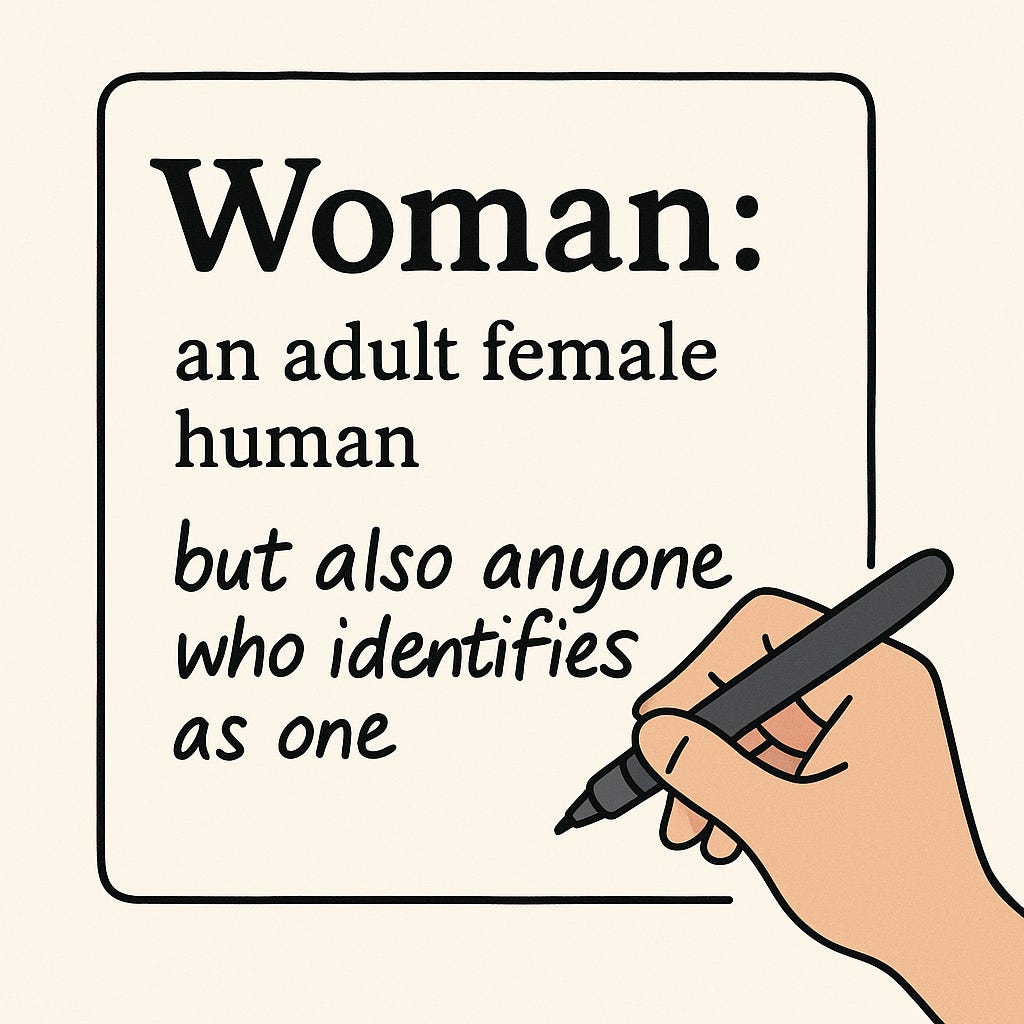
Wikipedia’s Woman page starts out sensibly enough: “A woman is an adult female human.” But then, “Typically, women are of the female sex…” emphasis emphatically ours… “and inherit a pair of X chromosomes, one from each parent.” What’s more, in addition to being adult female humans who are typically of the female sex, “some women are transgender, meaning they were assigned male at birth.”
Meaning some women are men. Meaning Wikipedia defines a woman as anybody who says he or she is a woman; it’s all good.
The Registrar of Unreality
Wikipedia is the cloud memory of the culture — the operating system through which society remembers itself. If a fact cannot be stated there, it becomes more easily disputed elsewhere.

When the uncomfortable truths of youth gender transition are dismissed as “misinformation,” the worst scandal in medical history remains unexamined by the public’s top source of information. When women cannot be defined as adult human females without adding that women can also be men, biological reality is downgraded to an identity costume.
Wikipedia is not the birthplace of the lie; it’s the certification office — the registrar of unreality.

Whether Wikipedia returns to its founding ideals is irrelevant. We must stop treating it as the arbiter of truth and build repositories of knowledge that do not erase us.
That’s what we’re doing here — publicly, visibly, without asking permission. We document. We remember. And memory rooted in reality is stronger than consensus.
If You Want This Work to Continue
Right now, 1 in 20 readers subscribes. That’s how we’ve gotten this far. If we can double that, we come closer to being unsilenceable.
No government institution funds us. No NGO foundation shields us. We are held up by the people who refuse to look away.
If you can, be 1 of the 2 in 20. Subscribe to support this work. This is how we stay independent, visible, and unerasable.
I used to donate to Wikipedia, because I used it often for factual information and believe in paying for services that are trustworthy and helpful. That ended when I observed exactly what is documented in this article. I saw intellectually rigorous, wholly respectable gender-critical authors characterized as "anti-trans," a blanket smear applied to anyone who dared challenge "trans" orthodoxy. I saw people who fought for gay rights in decades past -- some now dead -- retroactively depicted as "LGBTQ (etc)" activists. In fact, gender identity wasn't even on the table when these people (I was one of them) were in the fight, and their support for gender ideology can hardly be assumed. As has been well-documented on this substack, AI -- fed by the same ideological morass that swamped Wikipedia -- is likely to substantially increase the spread of pro "trans" bias presented as fact. Sadly, people prefer to be spoon fed, rather than do their own thinking; unfortunately, Wikipedia and increasingly AI are holding the spoon.
As a retired journalist, I'm impressed with the quality of articles on this Substack. So, I am becoming a paid subscriber. Thank you for your work.
Thanks for another excellent article. I wonder whether this organization can join with like organizations (Genspect USA etc) and appeal to Wikipedia’s founders themselves to modify the content on this? Looking for ways to stop the misinformation battle over and over.