


Oh my lord, it is so hard to keep up. Please no more NBA players discovering your female identity and declaring for the WNBA draft until I finish writing this damn story. And then I’ll hold your beer.
Also an extra special pretty please with a cherry on top, please no more WNBA players and coaches saying things like “I would welcome a trans athlete on my team or against my team anytime” or “ Um, you know, as I said, I’m not educated enough in terms of transgender and transitioning to give you a smart answer. Um, I just don’t feel like exclusion is an answer.”
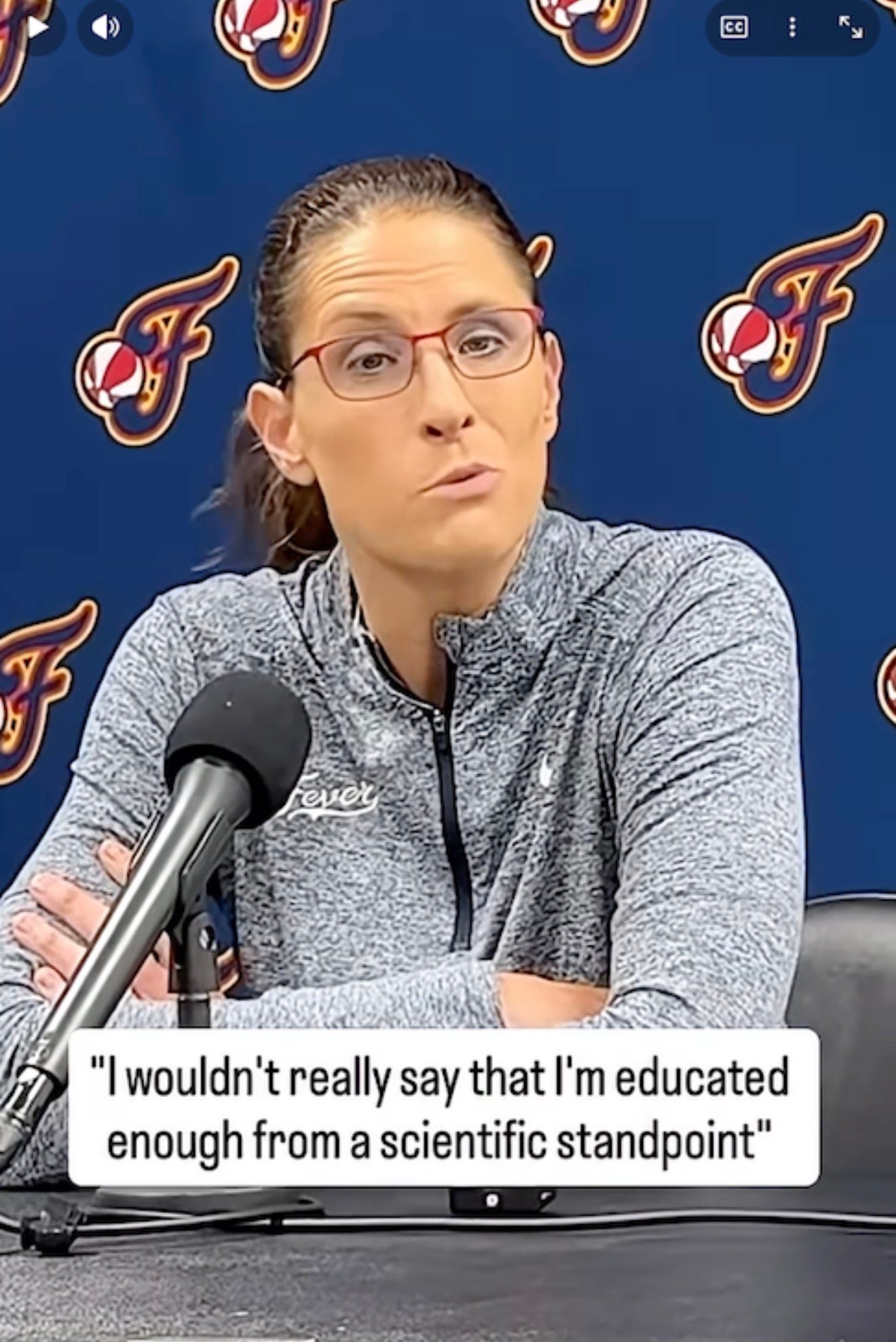
Indiana Fever coach Stephanie White/OutKick on YouTube
Players, coaches, owners, don’t you see? You don’t have to do this anymore. Just because the straight white “conventionally attractive” bestie of Caitlin Clark (no shade, Caitlin, I’m making a point) said the sensible thing doesn’t mean you can’t say the sensible thing. O great and good of the WNBA, you rode the LGBTQIA2S+ wave for many a moon, and at one time it served you. But we are in a different time, and a reckoning has arrived for what Riley Gaines calls “the most woke league in the history of ever.”
The U.S. Supreme Court, the NCAA, the IOC, World Athletics, and the Women’s Tennis Association (WTA) have weighed in, with the latter three requiring one-time, non-invasive screening for the SRY gene to protect the female category. Easy as pie.The SRY gene is located on the Y chromosome that triggers testis development in a fetus rather than ovarian development — it’s the master switch for male-typical sexual differentiation. Screening for it prevents Imane Khelif from beating up more women and Caster Semenya from leaving them in the dust. Look into it, WNBA.
As far as public opinion is concerned, the no-men-in-women’s-sports issue is 80-20, the 80 has found its voice, and the voice is getting loud. I don’t mean loud in the way of this moron with a bullhorn screaming “Protect Trans Women!” and “You’re a c**t!” at entirely peaceful supporters of sex-based reality for a solid hour before the Lynx-Fever game.
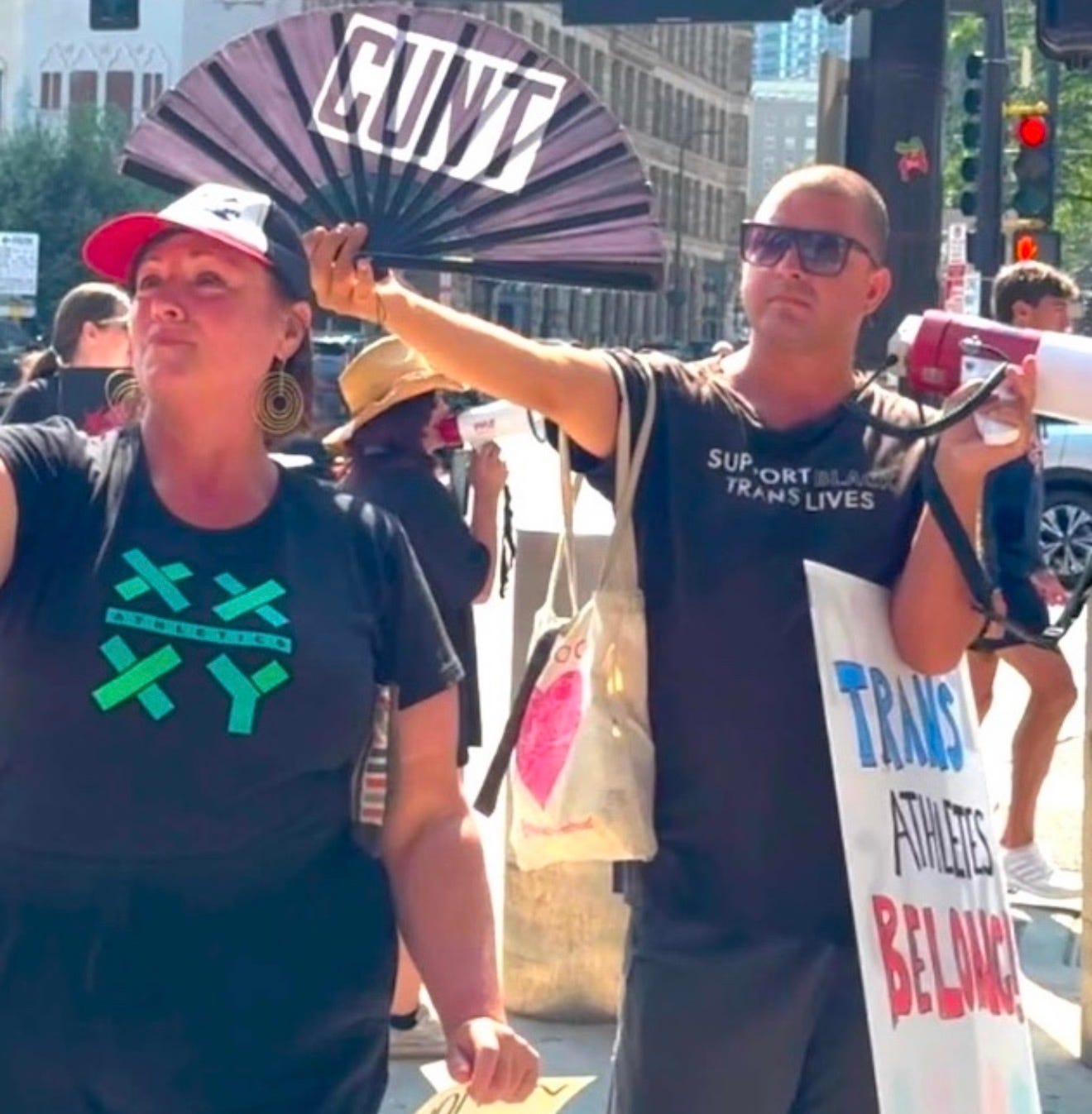
I mean loud as in the supporters’ clear and true and righteous response: “Let Women Speak! Let Women Speak!” That response is reverberating across the country and the culture, and it’s getting louder by the hour.
Video clip from Amy Sousa’s livestream/Known Heretic on YouTube
Given numerous opportunities to clarify their own opinions about whether a man claiming to be a woman should be eligible to compete in the WNBA, coaches have blathered on about “inclusion” and “trans athletes belonging.” Some players like Gabby Williams said they would welcome a “trans athlete” as a teammate or a rival. (One former player, Lashiya Clarendon, identifies as both nonbinary and transgender. She had a double mastectomy in 2021 and retired several years later for “mental health reasons,” according to the league. No actual men play in the WNBA as far as anyone knows, although rumors have swirled around baritone Brittney Griner for years.)
WNBA honchos remained silent as the tomb until late last week when former NBA players Enes Kanter Freedom and Royce White jumped the shark by “coming out” as trans and declaring for the 2027 WNBA draft. Apparently, that particular farce did it. On Friday WNBA commissioner Cathy Engelbert, in a memo to WNBA teams obtained by the Associated Press, said that this “complex and nuanced” topic would be discussed at a meeting this week, adding pointedly that “our player eligibility rules, unlike the eligibility rules of some other leagues and governing bodies, are collectively bargained.”
Which brings us to the 2026 Collective Bargaining Agreement, between the WNBA and the Players Association (WNBPA). “Only players who are women are eligible to play in the WNBA,” the agreement reads. In normal times, that line would be clear and sufficient, but these are not normal times. Because the agreement doesn’t define “women,” one could plausibly argue that the WNBA does not exclude men who claim they’re women. The agreement bars “synthetic” testosterone at any level – not a problem for Royce White or Enes Kanter Freedom.
So that’s where we are – Cloud Cuckooland, as of this writing. How did we get here?
How We Got Here
Several weeks ago a guard for the Indiana Fever named Sophie Cunningham displayed at once a sense of grace and a firm grasp of the obvious in an interview with ESPN: “I got a lot of negative feedback about me hating trans. And I’m like, ‘I never once said that. I think that I am here to extend love. But I also think that with love is truth. And I want to protect young girls in a locker room, or young girls in sport who shouldn’t have to go against biological men.” Responding to predictable backlash, Cunningham clarified that opposing males in the female category was “common sense.”
An outpouring of oh-hells-yeah ensued across social media, the reality-based community (you know who you are), and in pregame rallies organized by Women Are Real, Amy Sousa, and Jennifer Sey. Held before Fever games in the sex-denialist strongholds of Seattle, Portland, and Minneapolis (more are planned!), the rallies brought together long-suffering terfs, girls fed up with boys in their sports, pissed off parents, and other normal people in peaceful, joyful appreciation of Sophie and women’s sex-based rights.
As you may have heard, the love attracted some hate.
At the Seattle Storm game, two 16-year-old girls wearing XX-XY t-shirts and holding “We love you, Sophie” signs were confronted and called “fucking insane” by a fucking insane part-owner of the Storm, Celeste Heaton. A feng shui consultant and holistic minister, Heaton said she hoped Jesus would forgive the girls for “coming here and pulling this shit.” She’s married to another part-owner, Lisa Brummel, the former long-time head of HR (!) for Microsoft.
At the Portland rally, a woman named Pam (dubbed “Pamtifa” for her supposed affiliation with Antifa) attempted to debate Kara Dansky; it did not go well for her.
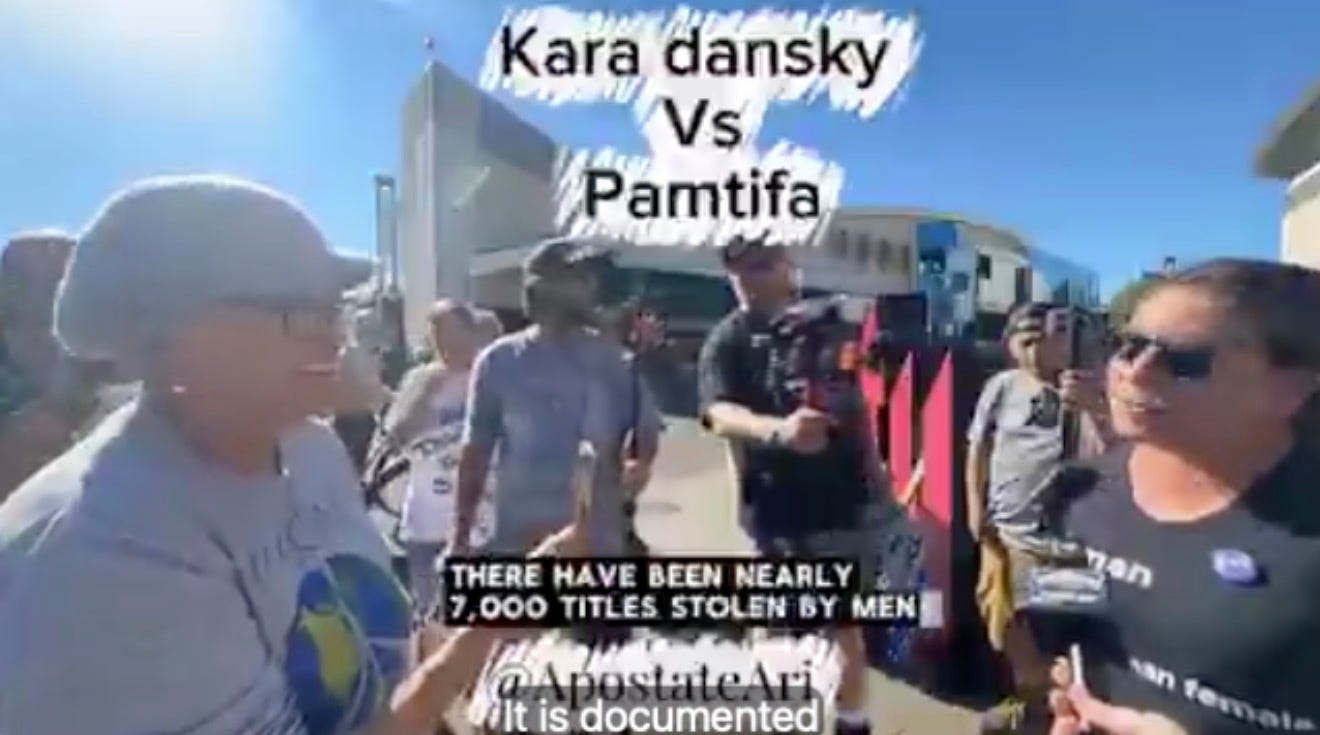
The Transphobic Historian on X
Riley Gaines and Jennifer Sey had to be escorted by security guards into the Minnesota game because of aggressive trans activists, who also ripped up supporters’ signs. Lynx fans booed Cunningham every time she touched the ball. Meanwhile, her Adidas shoe line sold out in less than four hours.
The Ketanji Brown (“I’m Not a Biologist”) Jackson of Professional Basketball and Other Preposterous Prevaricators
In this trainwreck of an exchange, a reporter asked Indiana Fever coach Stephanie White “what’s your stance on men participating in women’s sports?” White replied that she’s “not educated enough from a scientific standpoint” to know, but “I don’t ever believe that exclusion is an answer.”
How much education does a professional basketball coach need from a “scientific standpoint” to know that if men weren’t excluded from women’s sports, women’s sports wouldn’t exist? That doesn’t mean “trans athletes” are excluded from sports. For approximately the gazillionth time, men and boys remain eligible to compete in the male category, regardless of how much makeup they trowel on, how big their cleavage is, and how they “identify.” Identities don’t play sports.
“Um, I know growing up I played with the boys all the time,” White continued. “So, there weren’t girls’ sports.”
Um, so, I guess that’s what we call a White lie. No doubt White played some hoop with the boys when she was a child, but there most definitely were “girls sports” at Seeger Memorial Junior-Senior High school in West Lebanon, Indiana, where she grew up and starred on the girls’ basketball team for four years. No boys were blocking the basket as Stephanie White set state scoring records that still stand.
While White claims not to be educated enough to venture an opinion, “I’ve chosen to educate myself about the space,” Minnesota Lynx coach Cheryl Reeve assures us. “I’ve chosen to listen to transgender families.” Noted.
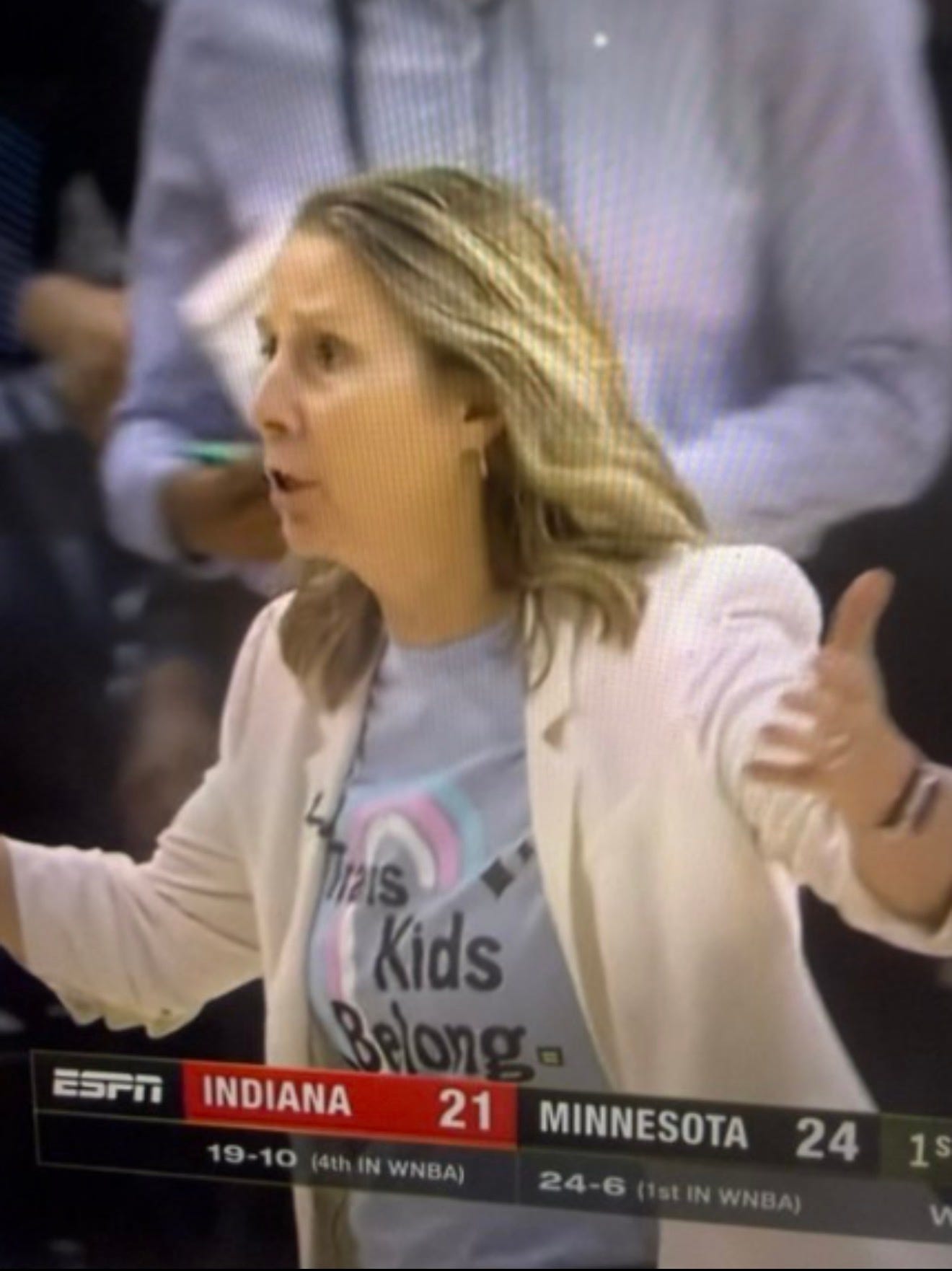
Minnesota Lynx coach Cheryl Reeve/ESPN
Reeve reveals that “years ago” she encouraged WNBA leadership to figure out “what are we going to do when this occurs…and what I know is exclusion is not the answer.”
Then, like Stephanie White, she resorts to lying.
““It is not the case that we have, quote, biological men in girls’ locker rooms,”
Cheryl, if I may invoke holistic minister Celeste Keaton, you are, quote, “fucking insane” if you expect us to believe that you believe that. In your state and in all states that organize scholastic scholastic sports teams by gender identity rather than by sex, locker rooms are organized the same way. If a boy plays on a girls’ team, you can bet he strips down in their locker room.
For Valkyries coach Natalie Nakase, “sports is about belonging” and – wait for it – “inclusivity.” Because of being “criticized” for her height and ethnicity, Nakase has had the “you shouldn’t belong here” conversation and “I don’t want that space, especially Golden State, to ever feel like that. So I’m all about women, little girls deserving to play, and that includes trans women.”
Nakase is comparing herself, a woman who has a disadvantage (she’s short) competing in women’s basketball, with a man who has an advantage (he’s a man) competing in women’s basketball. WT actual F?
The WNBA and the Trans Industrial Complex
It’s no coincidence that the musings of WNBA coaches and players sound like a DEI struggle session (with Cunningham clearly not getting the memo). The league has a long history of building relationships with major LGBTQ+ advocacy organizations and running internal “inclusion” training. It has partnered with self-described “affirming” youth organizations like GLSEN and the Trevor Project. The league has also platformed players and coaches who pushed the NCAA to keep allowing men in women’s sports and have publicly opposed bills that ban it.
Although Cheryl Reeve has not stated flat out that she’d be down with Royce White in her league, she did say in a 2021 Sports Illustrated op-ed “I am proud to speak up in support of the right of transgender women and nonbinary athletes to compete in women’s sports. When we welcome all woman athletes, including transgender woman athletes, to bring their full authentic selves to the game, we are stronger as individual players and as a team.”
Moreover, WNBA uniform jersey sponsors are or have been among the most prolific providers of gender transition treatment, including (pre-Trump) for minors: Yale New Haven Health (Connecticut Sun), Kaiser Permanente (Golden State Valkyries), UCLA Health (Los Angeles Sparks), Providence Swedish (Seattle Storm), Mayo Clinic (Minnesota Lynx), and UChicago Medicine (Chicago Sky).
One of the Indiana Fever’s jersey sponsors is Eli Lilly, among the “major companies present in the United States Sex Reassignment Hormone Therapy Market” according to a report from Research and Markets. The founder and CEO of Salesforce, the Fever’s other jersey sponsor, is Marc Benioff, who endowed UCSF Benioff Children’s Hospitals, a key provider of pediatric gender treatments in San Francisco and Oakland.
Remember the Lesbians
The WNBA’s connections with Pride and related organizations stretches back to a time before LGBTQ+ became all about the T. The LA Sparks were the first team in any pro sport to officially recognize Pride Month, in 2001. The league launched WNBA Pride in 2014 — the first dedicated Pride campaign by a U.S. pro league, including a nationally promoted and televised Pride game. That same year the league began a long partnership with GLAAD (a legitimate media watchdog calling out unfair treatment of gays and lesbians before it became a trans mouthpiece).
The WNBA’s pioneering involvement with Pride is largely because of the L. From the jump, the WNBA has had lesbians galore. Five out of seven female WNBA coaches – including Reeve and White – are lesbians (all out, married to women), as are, by common estimates, nearly 40 percent of its players. An Autostraddle piece names 53 “gay” WNBA players, but that’s only counting those who are publicly out.
Five of the 15 WNBA teams have at least one lesbian co-owner (out, married to women), and two of those teams have more than one – the Atlanta Dream has two lesbian co-owners and the Seattle Storm has four. And of course lesbians have always constituted a sizable portion of the fanbase.
Unfortunately, in a by-now familiar story, the WNBA’s LGBTQ+ alliances became increasingly trans inflected, reflecting the trans takeover of the LGBTQ+ landscape more broadly and by extension the erasure of lesbian culture – too often at the hands of, yes, lesbians themselves. By aligning itself so doggedly with trans, this organization that relies so much on lesbians has colluded in doing them harm.
Lesbians, especially younger women, are uniquely affected by the debate over men in women’s sports and by the trans issue in general. Because they play sports and coach sports in disproportionately large numbers, they’re more likely than other women to have direct experience with the problem. At the same time, younger lesbians especially are pressured to accept men claiming to be women as romantic partners or “female” peers, as these men invade lesbian dating apps and social groups, as well as women’s sports.
Then there’s the pressure on sporty, same-sex attracted young women to call themselves trans or nonbinary, to get double mastectomies and take testosterone – horrific pressures that were unfathomable when Stephanie White and Cheryl Reeve were coming up.
Both trans-identified men and trans-identified women are more likely to be attracted to women than to men, making younger lesbians more likely to know trans-identified people, socialize with them, sympathize with their struggles – and conversely see alternative perspectives as cruel or bigoted. Among some older lesbians who haven’t been paying attention, I’ve noticed a tendency to see trans rights as Gay 2.0 – a natural and good extension of the movement we all knew and loved, what decent person could oppose that? Certainly not Celeste Heaton.
That’s how Sophie Cunningham, Riley Gaines, and so many of us (including sex-realist lesbians) get labeled grifters and bigots by people who see themselves as righteous. The phrase “toxic empathy” gets thrown around a lot, but sometimes it has valence.
The SRY Screen and the Path of Least Resistance
Because they haven’t bothered to define “women,” in their collective bargaining agreement, the WNBA is operating with no sex-verification mechanism. Given that the league’s own players and coaches have been forced into public, unresolved arguments about this exact question, the absence of a defining mechanism is no longer a neutral position. All kidding and good fun aside, men playing in this league would kill it. It’s time for the WNBA to implement the SRY gene test.
Ideally the WNBA does what the WTA will do – test all current and future players. However, this change could provoke strong resistance from current players; some like Brianna Turner have already come out against it.
The league could sidestep further pushback by applying the policy prospectively rather than retroactively: write the rule so testing applies to all players entering the league starting with the 2027 draft class and any new signees from that point forward, while grandfathering current players under the existing (untested) framework. That gets a verification standard in place immediately for the pipeline coming in, avoids a possibly embarrassing fight over testing current players (frankly, who knows what they’d find?), and gives the league several seasons to build institutional buy-in.
Stop the Word Games and Step Up for Women
With its one-sided, vague rhetoric about “belonging” and “inclusivity” applied only to trans athletes, the WNBA is reinforcing the message that women’s sports don’t deserve to be protected. The league needs to stop playing language games and acknowledge that this is a zero-sum game. Women aren’t support animals for disturbed men, and the female category is not a dumping ground for mediocre male athletes. Finally, how about a lesbian player or coach join Sophie Cunningham in speaking up for women’s and girls’ sex-based rights? The time is ripe, and it’s easier than you think.
Our opponents are well-funded. We aren’t. Everything we do—from publishing stories like this one to organizing testimony across the country—depends on the support of people just like you. If this work has value to you, please become a paid subscriber or make a donation today. Your support keeps this movement alive.
Visit our website to help fund the reporting, advocacy, legislative testimony, educational outreach, and community-building efforts that make the LGB Courage Coalition a leading national voice for evidence-based care and homosexual rights. Paid subscriptions and donations are what make all of this possible.
To support our work or submit a tip, visit the LGB Courage Coalition website.
This is an excellent post Bev. Thanks for giving me a chuckle this morning.
A thorough review of utter madness; great work, Beverly!
I greatly admire Cunningham; at a young age, her integrity and courage put to shame elders in positions of leadership who are, conversely, demonstrating self-interest and cowardice. (I say this because the option -- stupidity so profound one needs "education" to distinguish between male and female -- is simply not possible among humans who can feed and dress themselves.) Enough, already, of mush-mouthed paeans to "inclusion," especially from lesbians willing to sacrifice female sports to gender ideology. As a lesbian and Lynx fan, I could not be more disappointed in Cheryl Reeve. And Stephanie White's cowardly retreat from supporting her own player -- a golden opportunity for a coach to follow a principled lead she would not herself risk -- is appalling. Realizing so many people live comfortably with their own lack of integrity and moral courage has been a sad awakening of my later life. In this case they persevere even, as you rightly note, after braver souls have made it safe to do what's right.
Oh, I watched the clip of Royce White announcing for the WNBA draft. Hilarious; I don't know how he kept a straight face. I assume Freedom is coming from the same place, forcing the league's hand to explicitly protect itself and players. If I recall correctly, a male Canadian weightlifter did similar to point out the absurdity of admitting males to female competition in that sport. It's a shame that men of principle have to step in for women who lack same, but I'm grateful to them.